Friday, October 15, 2021

Ingenuity

  On February 18, 2021, the Perseverance rover landed on Mars with the Ingenuity Helicopter strapped to its underside. This pair separated soon after their landing and since then, they have been operating independently to carry out their assigned missions. However, in the last couple of weeks, ingenuity has been having troubles.

The original plan was for the helicopter to test its ability to fly in the thin Martian atmosphere which is approximately 1% of that on earth. It was originally intended that the helicopter would make five flights to survey the ground and prove its flight worthiness, however, it has already performed 13 separate flights at this point.

The last flight was on September 5 because as of late with the changing seasons on Mars, the air pressure on Mars is lower than the engineers expected the helicopter to have to fly in. The problem with this is that because of the lower air pressure, the helicopter can’t produce enough lift to take off anymore. In mid-September, they attempted to fly the helicopter by spinning the blades at a higher speed, however, the flight servos were found to be slightly off-angle, and as such, the flight was canceled.

Currently, from our perspective on Earth, Mars is just coming out from around the far side of the sun so we can finally start to get a better idea of what is going on. If they are able to get everything working again, we may see Ingenuity fly again, hopefully within the next month. If the people working on the project are not able to get the helicopter flying with the higher rotation speed, the program will probably be simply canceled as it would take about a year for the pressure to rise again.


Friday, October 8, 2021

Facebook, what is going on?

    A lot has been going on at Facebook this week and none of it is good for them, but it could be for the rest of us. Between a data breach, the entire platform including Instagram and WhatsApp being down for 6 hours, and allegations brought by a whistleblower, there is certainly no shortage of interesting things to talk about.

    The most notable of these to most people is the fact that on Monday, Facebook, Instagram, and WhatsApp were offline for about six hours. The problem that caused this outage involved something called BGP. Essentially what happened is Facebook’s servers made a mistake so that when someone wanted to go to Facebook and their ISP tries to retrieve its location on the web, it returned an invalid location instead of pointing at the desired location that the user wished to visit. As always, conspiracy theories have abounded, however, it appears the issue was a simple mistake by a Facebook employee.

    The very next day, Facebook whistleblower Frances Haugen made an appearance before Senate to testify about the things that she learned about the company while working there on the civic-integrity team. Her testimony could be summarized by saying that Facebook’s products harm children and weaken democracy. Facebook has allegedly made numerous decisions that have prioritized money for Facebook over the good of the public. Along with this came a study of teenage girls that found that 1 in 3 teen girls thought that Instagram made them more unhappy about their bodies. Facebook has disputed these findings, but things aren’t looking good for the company. This isn’t the first time that Facebook has had issues with the law and regulation, but it will hopefully push lawmakers to finally do something.

Friday, October 1, 2021

The Global Chip Shortage

    The global chip (microchip) shortage is a huge problem for many industries. Caused by a variety of different issues ranging from a global pandemic to unexpected demand, it is having huge consequences. It is a huge challenge for consumers and manufactures alike as it impacts computing, cars, household appliances, and many other industries.

    As one would expect from such a shortage, the industry that it is having the largest impact on is the semiconductor industry. Building a pc is significantly more difficult right now than it usually is because many parts are often sold out. Making the situation worse, scalpers are buying up graphics cards and trying to resell them at higher prices which is only increasing the issue. It is also having an impact on larger companies as they often are needing to use different components than they would like as they have a hard time getting enough of the components that they need for their electronics.

    Car manufacturers are also having a hard time keeping up with demand simply because of the processor that they need for their vehicles. Just the absence of one small component can completely stop production. This has also caused the price of used cars to rise because people can’t purchase new ones.

    So why is this all happening? There are many factors at play here and unsurprisingly, COVID-19 is one of them. Many companies, especially car companies expected that with a pandemic and people being laid off of work, they would have less money to spend on luxury items, thus hanging onto older things for longer. While for the auto industry this did happen for a couple months, after people started to realize the minimal effect it was having, demand increased again. However, with orders for the processors already canceled and semiconductor fabs working at 100%, they were unable to get the chips they needed. The increase in video conferencing and work-from-home also made sure that computer manufactures were plenty busy as people rushed to upgrade their home setups.

    Overall, the problem breaks down to poor planning and having everything based around a couple of countries instead of diversifying the means of production. This huge shortage will not be solved quickly as fabs take years to build. We will simply have to get pretty comfortable with this for the next while.

Friday, September 24, 2021

FTC Freight Frenzy


    Last week on Saturday, September 18, FIRST (For Inspiration and Recognition of Science and Technology) announced the challenge for the 2021-22 FTC (FIRST Tech Challenge) season. Immediately following the announcement, hundreds of teams from all over the world started to analyze the game and come up with a solution to the challenge. This year’s challenge, Freight Frenzy, for 7-12th graders, involves scoring small whiffle balls, boxes, and rubber ducks into different goals placed around the field. Teams will design, build, and program a robot that fits within an 18^3 inch box to complete the goals outlined by the challenge. For every match, teams will ally with another team and compete against two other teams on a 12*12ft playing field, trying to score as many points as possible. Every match starts with a 30-second autonomous period in which the drivers can’t control the robot manually but are only controlled by in-game elements; followed by a 2-minute driver-controlled period where the robots are controlled manually.

    This season, the teams must pick up these game elements from the corner of the field, drive over a small barrier, and then place them on a 3-tiered goal or onto a shared hub that needs to be tilted in their favor. In addition, the boxes have differing weights, adding the potential need to sort them to place them in more favorable locations. In addition, there are elements to the game that make it advantageous for teams to scan the field for different scoring opportunities during autonomous. Finally, at the end of the driver-controlled period, the teams can place a team-created scoring element on top of the goal and roll rubber ducks onto the field for additional points.

    This challenge provides many opportunities for the students to learn about how to design, build and program a robot. When I was in 8-12th grade, I competed on an FTC team, 12043 Power Surge, in similar challenges, winning the state championship twice. This year, as a college freshman, and my old team retired, I am mentoring a younger team, 13377 Blackout. I have seen what a profound impact this program can make on the students and that is what inspired me to give back by helping to teach the next group of students.

    If you would like to learn more, you can watch the game reveal video: FTC Freight Frenzy

Thursday, September 16, 2021

Inspiration 4

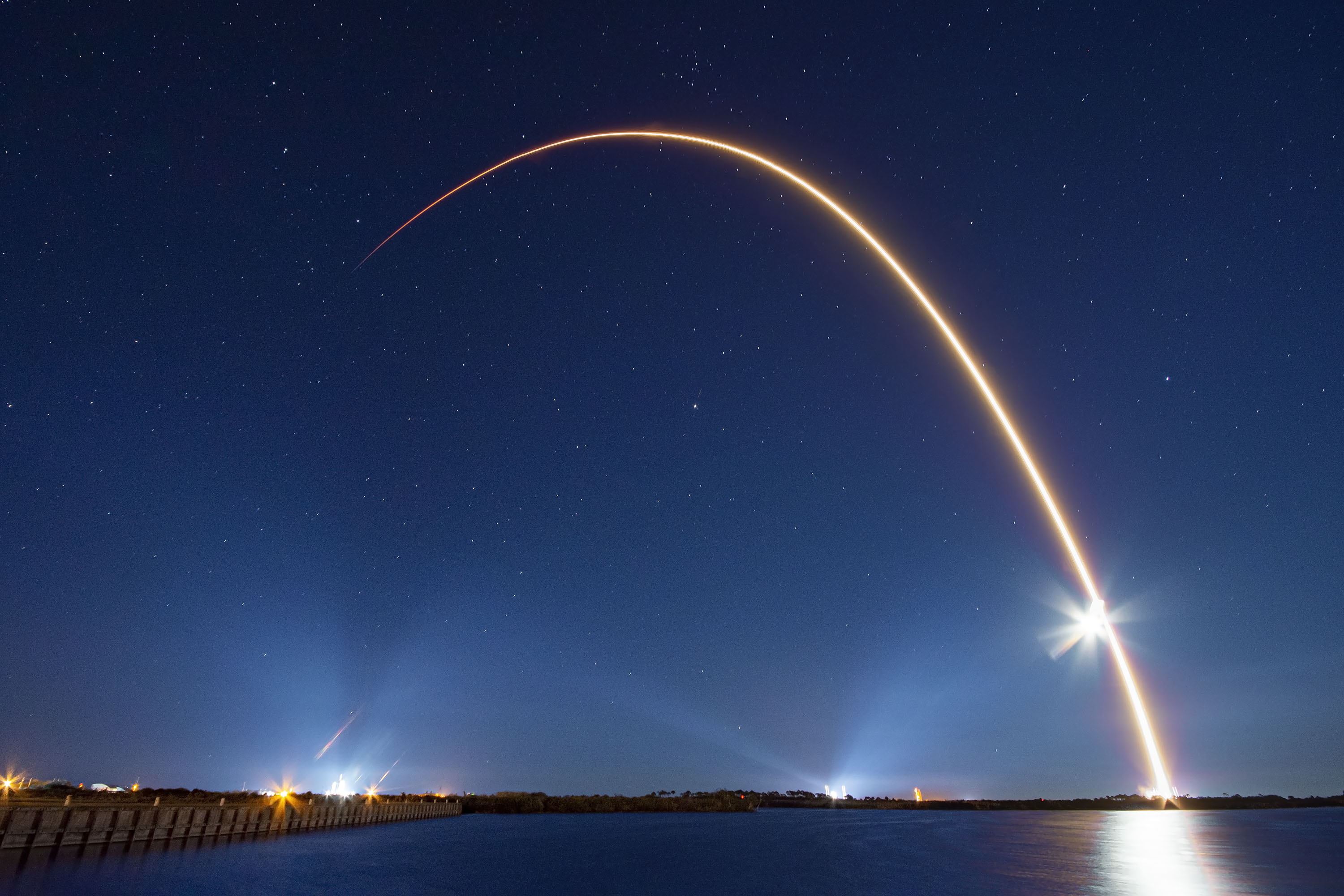
     On Wednesday, September 15, 2021, four civilians launched into orbit where they will stay for three days before returning to earth. Launching off from launch complex 39a aboard their Falcon 9 rocket, they flew into a higher orbit than the International Space Station where, from 367 miles in altitude, they can get amazing views of Earth and the vast expanse of space. The crew dragon capsule that they rode in was modified slightly from its previous flights to the ISS. Their capsule does not need to be able to dock with the space station so the docking adapter was replaced with a plexiglass dome, allowing them to get even more amazing 360° views.

               The four crew members are Jared Isaacman, the billionaire paying for the flight, Hayley Arceneaux, Dr. Sian Proctor, and Chris Sembroski. Commander Jared and Piolet Sian needed extra training, but all four members trained for months in preparation for this flight. Another interesting fact about one of the crew is that Hayley Arceneaux, a cancer survivor and physician for St. Jude, will be able to claim to be the youngest American ever in space at 29 years old as well as the first with a prosthetic.

               While the primary purpose of the flight is for tourism and curiosity, they will be doing some experiments while in space. Part of this is that all four of them are simply normal people and not held to the physical requirements that NASA astronauts are held to. It will be interesting to see how space affects them over their short stay in orbit. They will also be doing tests involving ultrasonic imaging as well and blood and brain activity while in orbit.

               Splashdown is planned for Saturday, September 17, 2021. With their arrival back on earth, a new age of space travel will be born. One in which normal people have the opportunity to go to space.

Thursday, September 9, 2021

This year in space


    The last year in space has been very interesting. From more private companies launching men to the edge of space to new rovers on Mars and the moon, there is plenty to be excited about beyond the confines of our planet.

    Launching on November 23, landing on the moon on December 1, and returning a sample to Earth on December 16, China’s Chang’e 5 spacecraft made a mission to the moon to collect and return rock from the moon back to earth. This is the first time since the 1970’s that this type of mission has been done and provided new material for scientists to study. The vehicle is completely solar-powered and marks a continued increase in the Chinese space program.

    The Perseverance rover and its companion helicopter, Ingenuity, landed on Mars using the same sky crane method as was used for the Curiosity Rover many years ago. This car-sized rover is being used to investigate the surface of Mars and cache samples to be returned by future missions. Ingenuity was the first vehicle to take a powered flight on another planet and is providing a lot of valuable data about flying in an atmosphere that is only 1% of the thickness of earth’s as well as scouting ahead of the Perseverance rover.

    There has also been a lot of progress made by SpaceX over the past year. Starship, their large rocket designed to bring people to other planets has made several test flights with the most recent one, SN15, being very successful with a successful launch and landing on May 5. They also sent their second crewed mission to the ISS carrying NASA astronauts Douglas Hurley and Robert Behnken to their home for the next couple of months. Finally, they have been launching the Falcon 9 rocket quite regularly to put satellites in orbit including their Starlink network.

    Multiple companies have also started to get involved in the private space launch industry. Notably, both Virgin Galactic and Blue Origin launched their founders, Richard Branson and Jeff Bezos respectively, along with other paying customers to the edge of space. One of the people that got to fly on this flight was Wally Funk, an 82-year-old pilot that has more flight time than nearly every astronaut. This is making space tourism finally possible for the first time in many years and hopefully, it will get more accessible over the coming years.

Friday, September 3, 2021

Lo and Behold: Reveries of the Connected World - Reflection

     Lo and Behold: Reveries of the Connected World is a great educational documentary about the history of the Internet and an explanation of how it impacts our lives today. It simply cannot be understated how much of an impact that the Internet has had on us. From communications, sharing of research, and education to digital transactions and the ability to work from home, it has forever changed how we live and work. A film like this really makes the listener reevaluate the things that we take for granted today that have such a profound impact on our lives.

    Towards the beginning of the documentary, there was a scene discussing the very beginnings of the internet featuring the first node of the internet in its original state. I found it very interesting how when the first monumental message had been sent to a computer at another university, it was noted with very little excitement, especially for something of such importance. This along with the fact of how forgotten it is today really surprised me as it was of such vital importance to society today, even if they didn't realize it at the time. And as it seems, not all that much has changed as partway through the first message being sent, the receiving computer crashed.

    After watching the documentary, I had a greater appreciation for how far technology and the internet have come over the past couple of decades. What probably interested me the most was the advances in autonomous car technology as I hope to work in the fields of autonomous navigation and operation. In the future, this technology will help to dramatically improve safety and efficiency.

    However, as with everything in life, every good thing comes with its own downsides. With our dependence on the Internet and electricity ever-increasing, the problem of what happens when that fails becomes more relevant. One example from the film of something that could bring our world to its knees is solar flares that could wipe out large portions of the grid, sending us back decades to a time without such modern conveniences. What exactly that could be like, we don't fully know but such an event would be devastating if we are not prepared.

    When writing a summary on a documentary such as this one, it may in many circumstances be beneficial to avoid doing external research as doing so could result in a mess of information. This could be problematic as it is not fair to include data not found in the documentary in a summary of it as it could change the theme of the summary.

More of my thoughts on privacy

                Many people don’t realize it but nearly all apps store unnecessary data about them and over 70% of mobile apps share user da...